Recent Middle East & North Africa Court Cases
DOI:
https://doi.org/10.67330/jphmet43Keywords:
valuation law, expropriation, Middle East, North Africa, Türkiye, Egypt, Gulf states, compensation, statutory sourcesAbstract
The baseline Middle East and North Africa installment of Recent Court Decisions surveys thirteen jurisdictions: Algeria, Egypt, Iraq, Israel, Jordan, Kuwait, Morocco, Oman, Qatar, Saudi Arabia, Tunisia, Türkiye and the United Arab Emirates. Several of them do not publish judgments systematically, so statutes and regulatory instruments carry more weight here than in the other regional surveys, and each item states what was and was not read. Most of the material concerns expropriation. For Türkiye the installment covers the European Court of Human Rights on de facto expropriation, the Court of Cassation's valuation-date rule for takings without expropriation, and Constitutional Court decisions of 2025-26 on the real-value guarantee, including the holding that a statute may not exclude age, rarity and artistic value from the price. For Egypt it reports the Court of Cassation's June 2026 ruling that a claim for compensation for an irregular taking is never time-barred, with value fixed at the date of taking, a separate award for loss of use, and interest from final judgment. It sets out the Qatari, Omani, Kuwaiti, Tunisian and Algerian statutes, a Moroccan decision on the weight of the court expert against the administration's committee, Israeli decisions on which estate is valued and on compensation for the years between taking and payment, and an Iraqi sale halted over the gap between the official valuation and comparable land. Shorter sections cover taxation, lending, valuer licensing in Saudi Arabia, Oman and Dubai, matrimonial and partnership valuations, and insurance and eviction indemnities. A closing section lists what remains unverified.Downloads
Download data is not yet available.
Published
2026-10-01
Issue
Section
Recent Court Decisions
License
Copyright (c) 2026 William B. Craytor (Author)

This work is licensed under a Creative Commons Attribution 4.0 International License.
All articles are published under the Creative Commons Attribution 4.0 International license (CC BY 4.0).
Under this license, anyone is free to share and adapt the material for any purpose, including commercially, provided appropriate credit is given to the author and the journal, a link to the license is provided, and any changes are indicated.
Translated editions of an article are covered by the same license as the English edition, which is the version of record.
How to Cite
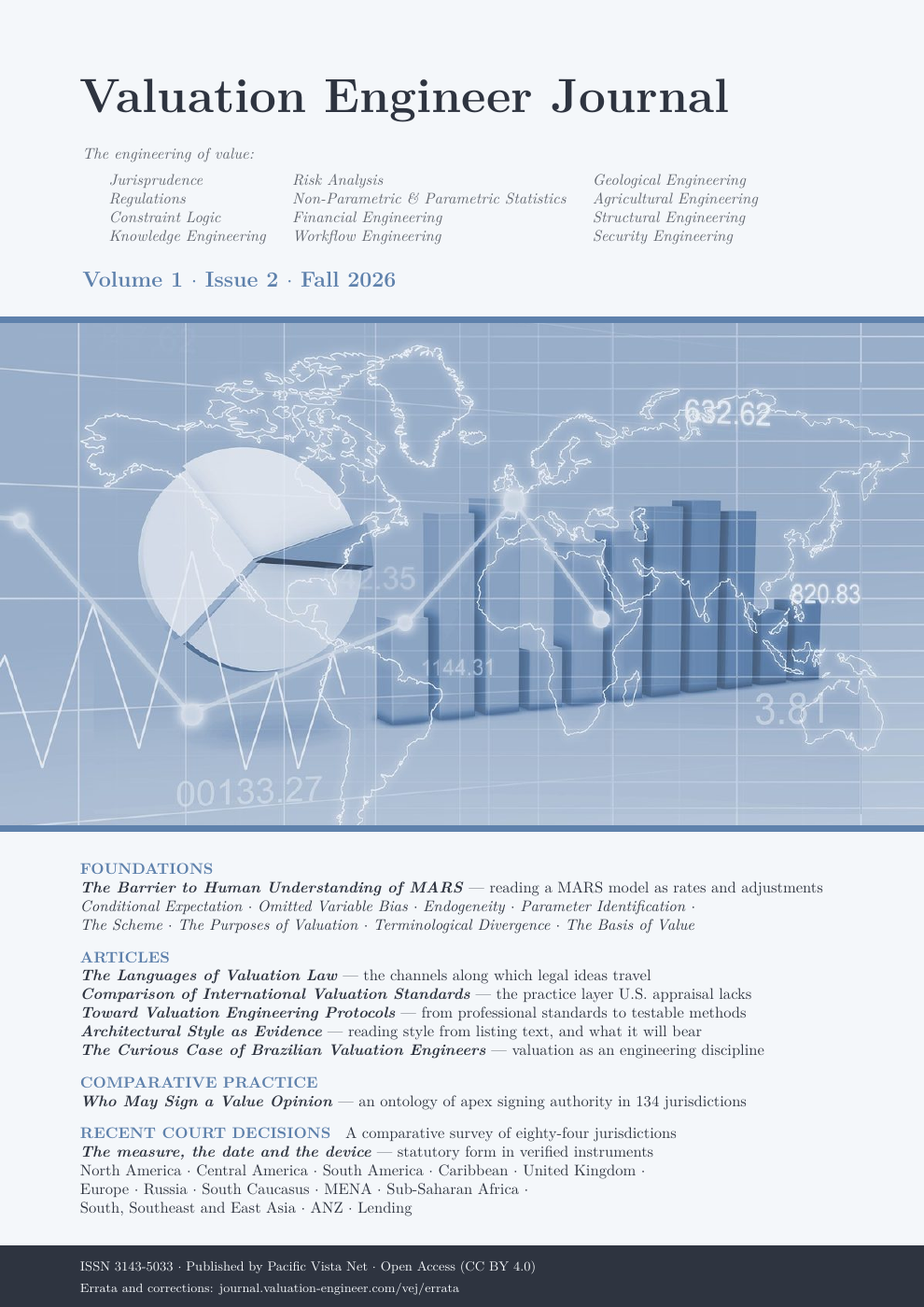
Recent Middle East & North Africa Court Cases. (2026). Valuation Engineer Journal, 1(2), 570-594. https://doi.org/10.67330/jphmet43